 Skip to content
 Trade Optimism Fades as New Threats Emerge
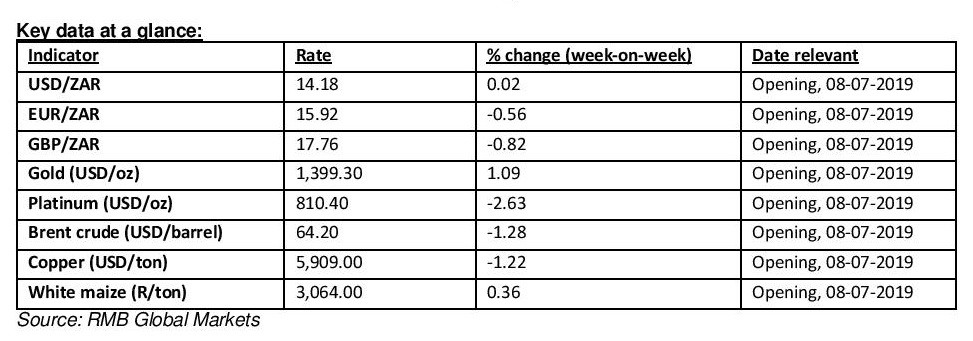
Commentary: 8 July 2019 – There was a raft of manufacturing data out last week. Factory activity shrunk across much of Europe and Asia in June while US manufacturers’ output grew at the slowest pace in more than two years. The downbeat numbers point to slowing global growth and intensifying geopolitical and trade tensions. While the US and China have agreed to a trade truce, analysts doubt this will lead to a sustained easing of tensions. Much more needs to be done. Tariffs continue to adversely affect business decisions and forecasting and are wreaking havoc with supply chains and costs. Adding to the skepticism is the threat of additional tariffs on $4bn worth of European goods due to the ongoing dispute over aircraft subsidies. In April, the US identified $21bn worth of European goods eligible to be hit with tariffs and plans to hold public hearings on the expanded list on the 5th August. While it remains unclear when the tariffs will come into effect, the EU has said it is open to negotiations but warned of retaliatory measures.
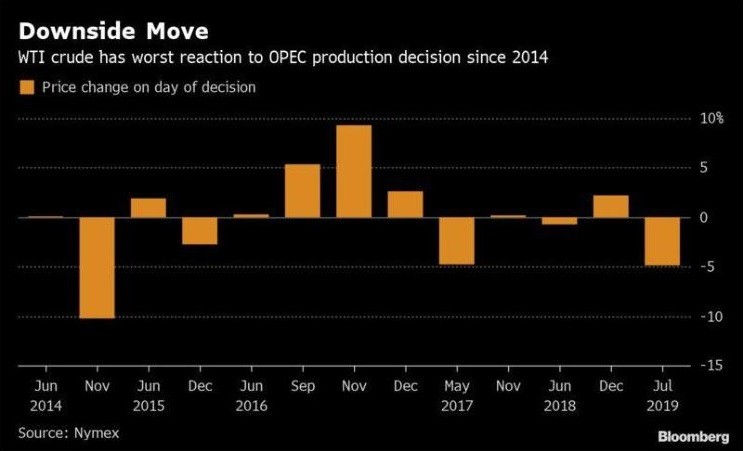
OPEC’s main producers find themselves in a predicament. They must reduce output to sustain prices, but the higher prices encourage more production from non-OPEC members such as the US, Canada and Brazil. Current trends in the market also present major challenges. The strong demand for oil, which has helped prop up prices, appears to be fading and growth in world demand is likely to fall by about 25%. The OPEC pact also leaves the door open for shale producers to grab more market share – the oil cartel’s share of the global oil market has fallen to its lowest level since 1991. The oil price had its worst response to the 1st July OPEC meeting in four years, after the cartel agreed to extend production cuts to 2020.
National Treasury has briefed the Appropriations Committee on the Minister of Finance’s authorisation of an R17.65bn payment to Eskom in April. The payment was aimed at helping the power utility service its debts and was the maximum amount allowable by the Public Finance Management Act. The R17.65bn is part of an R23bn allocation that was announced in the February Budget. Without knowing exactly how much Eskom needs and how much of the R230bn will be frontloaded, it is difficult to estimate the impact on the fiscus. Nonetheless, the deterioration in the growth outlook, coupled with additional SOE support, will see Treasury miss its budget-deficit estimates. Moreover, the support is still unlikely to be sufficient to place the utility back onto a sustainable footing. Local high-frequency economic data for the second quarter shows somewhat of a recovery, with manufacturing output sharply higher, while retail sales were boosted by Easter spending in April. Despite the improvement in manufacturing production and sales, mining output continues to contract, while vehicle sales remain weak. Hence, it is still quite a mixed picture in terms of how strong a rebound we can expect in quarter two.
The manufacturing Absa PMI nudged to 46.2 points in June, up from 45.4 in May, due to a moderate improvement in business activity. However, the index tracking expected business conditions in six months’ time declined, indicating that any recovery is likely to be short-lived. The World Bank has reduced its growth forecasts for SA by 10-20 basis points to 1.1%, 1.5% and 1.7% for the next three years. These estimates might still be somewhat optimistic and we could expect further downward revisions over the course of the year. The World Bank cited weak mining production and domestic policy uncertainties as reasons for the weaker growth outlook, but has indicated that it expects elevated policy uncertainty to moderate over the medium-term.
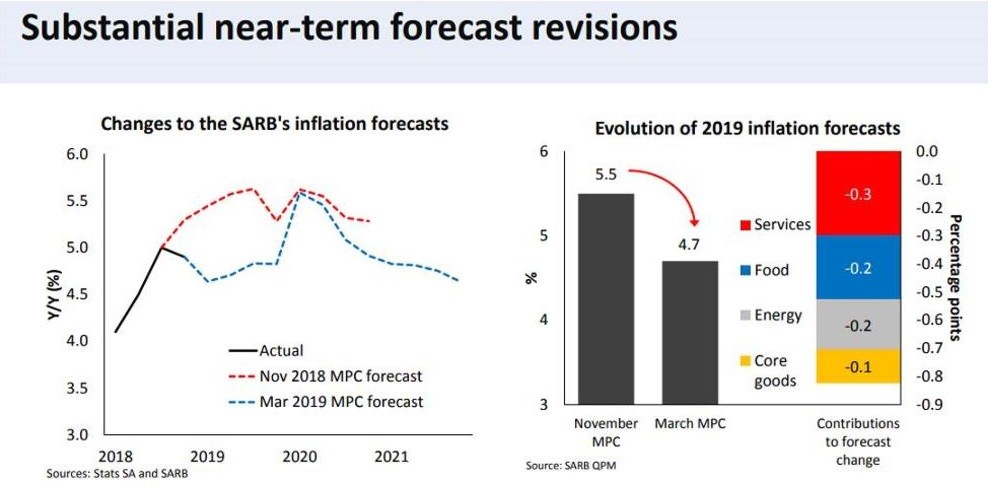
Although the Reserve Bank seems to be on track to achieve its 4.5% inflation target in 2019, it has warned that the Monetary Policy Committee would like to see inflation remain close to the midpoint of the target range on a more sustained basis. We could see a marginal reduction in the Bank’s CPI and growth forecasts at its upcoming meeting that could prompt a more dovish monetary policy stance and many analysts therefore believe there is a high likelihood of a rate cut this month.
By Bridget Kelly, Santam
Disclaimer: This research has been written by the economist at Santam Structured Insurance Limited (“the Insurer”). Whilst all care has been taken by the Insurer in the preparation of the opinions and forecasts and provision of the information contained in this report, the Insurer does not make any representations or give any warranties as to its correctness, accuracy or completeness, nor does the Insurer assume liability for any losses arising from errors or omissions in the opinions, forecasts or information irrespective of whether there has been any negligence by the Insurer, its affiliates or any officers or employees of the Insurer, and whether such losses be direct or consequential. Nothing contained in this document is to be construed as guidance, a proposal or a recommendation or advice to enter into, or refrain from entering into any transaction, or an offer to buy or sell any financial instrument. This communication is not intended nor should it be taken to create any legal relations or contractual relationships. Santam Structured Insurance Limited is an Authorised Financial Services Provider under South African law (FSP 1027).